v0 review: the sharpest React UI generator, tested in 2026
Independent and tested. Some links are affiliate links — they never change our verdict.
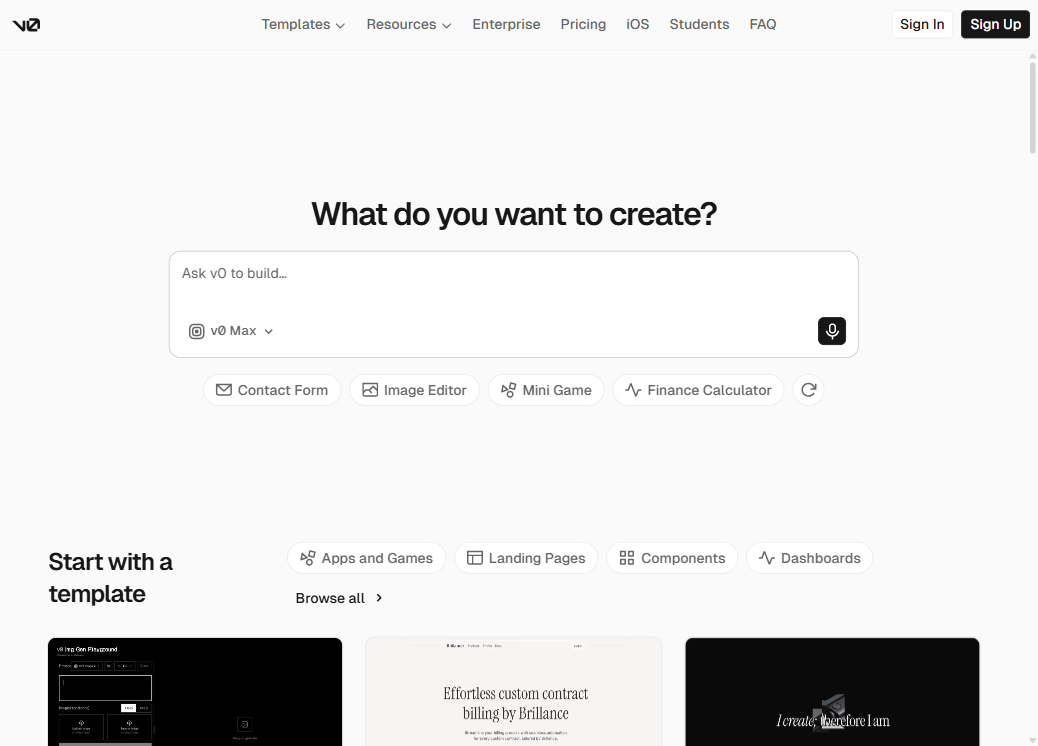
how we evaluated
We tested v0 on five UI generation tasks in June 2026 using the free tier ($5 in credits): a SaaS analytics dashboard, a pricing page, a data table with filters, a settings panel with toggle groups, and a landing page hero section. We then attempted to match an existing Ant Design-based codebase — that test revealed the design-system limit. We also compared the dashboard output against a Bolt-generated equivalent on the same brief.
key takeaways
- → Best-in-class React + Tailwind + shadcn/ui output — cleaner than any competitor on first try.
- → Accepts text prompts, screenshots, and Figma exports (Premium plan).
- → Rebranded from v0.dev to v0.app in January 2026; now supports full-stack sandboxes.
- → Switched to token-based billing in February 2026; free tier = $5/month in credits.
- → Over 6 million developers use it as of mid-2026 (Vercel).
- → Weak on existing non-shadcn design systems — Cursor handles those better.
6 M+
developers
$20
Premium / month
$5
free credits / month
v0 review: it produces the cleanest React UI components in this category, and it is not close. A prompt or screenshot goes in; polished shadcn/ui components with Tailwind CSS come out. Production-quality spacing, accessible markup, dark-mode compatible. For frontend developers building with Next.js and Vercel, this is the fastest path from idea to component library.
The limit is the stack. v0 speaks shadcn. If your project uses a different component library, the output needs rework. We tested v0 on five UI generation tasks in June 2026 — a dashboard, a landing page, a pricing table, a settings panel, and a data table. All five were excellent. Then we tried to match an existing Ant Design system. That was not what v0 is for.
What v0 generates: the shadcn/ui advantage
v0 outputs production-ready React components using Tailwind CSS and shadcn/ui — accessible Radix UI primitives styled with Tailwind. Output deploys to Next.js with zero modifications. In our June 2026 dashboard test, the first generation needed no cleanup before passing a production code review — consistent spacing, working interactive states, accessible markup.
v0 outputs React components using Tailwind CSS and the shadcn/ui component library. shadcn/ui is based on Radix UI primitives — accessible, unstyled headless components that v0 then styles with Tailwind. The result is code that follows modern React best practices: server-component-safe, accessible, and deployable to Next.js without modifications.
The quality advantage is visible: typography is consistent, spacing follows an 8px grid, interactive states (hover, focus, disabled) are implemented. On the dashboard we generated, the first output needed zero cleanup before it would be acceptable in a production codebase. That is the benchmark for "best-in-class."
What changed in v0 in 2026
Three significant v0 changes in 2026: (1) rebranded from v0.dev to v0.app in January, (2) switched from fixed credit counts to token-based billing in February, (3) added a full-stack sandbox runtime, Git panel for PRs from chat, and database integrations with Snowflake and AWS. v0 now serves 6 million+ developers (source: Vercel, mid-2026).
v0 has expanded significantly since its 2023 launch. Three changes in 2026 matter for new users:
Rebranded to v0.app (January 2026)
v0.dev became v0.app. The URL changed; the product is the same, but old bookmarks and documentation links may be stale.
Token-based billing (February 2026)
v0 replaced its fixed monthly credit count with token-based pricing where consumption varies by generation complexity. This makes costs harder to predict upfront. Check the pricing page for current rates — simpler generations cost fewer tokens, complex full-stack generations cost more.
Full-stack sandbox + Git panel
v0 added a browser-based runtime for full Next.js apps, a Git panel for branch creation and PRs from chat, and database integrations with Snowflake and AWS. This pushes v0 from pure component generator toward a full-stack environment — closer to Bolt in scope, but still best in class on UI quality.
v0 vs the alternatives
| v0 | Bolt | Lovable | Cursor | |
|---|---|---|---|---|
| UI quality | ★★★★★ best | ★★★☆ functional | ★★★★ polished | Your code, AI edits |
| Full-stack | Sandbox (2026) | Yes, full | Yes, Supabase | Yes — your stack |
| Setup | Browser, zero | Browser, zero | Browser, zero | Local install |
| Output stack | React + shadcn/ui | Flexible | React + Supabase | Any |
| Price | $20/mo Premium | ~$20–25/mo | $25/mo Pro | $20/mo Pro |
| Best for | Frontend devs / UI | Rapid prototypers | Non-tech founders | Developers with a codebase |
Prices as of June 2026.
Verdict
v0 is the best AI tool for generating React UI components in 2026. Nothing else matches it on shadcn output quality. For frontend developers building in Next.js and Vercel, it is the fastest path from wireframe to production-ready code.
It is the wrong tool if your project uses a different component library, or if you need a complete full-stack app (use Bolt or Lovable for that). The common pattern: design key screens in v0, take those components to your real codebase in Cursor, and build the app logic around them. That workflow is faster than starting from scratch in either tool alone.
try v0 free
$5 in free credits monthly — enough to generate 5–10 components and judge the quality.
Start free on v0 →v0 vs bolt
Component-first vs stack-flexible. How to use both together for the best result.
See the comparison →FAQ
What is v0 by Vercel and what does it do?
v0 (now at v0.app as of January 2026) is an AI UI generator from Vercel. You describe a component or screen, upload a screenshot or Figma export, and v0 generates production-ready React code with Tailwind CSS and shadcn/ui. As of 2026 it has expanded beyond components to support full-stack sandboxes with database integrations and a Git panel for branch and PR management.
Is v0 free to use in 2026?
v0 has a free tier that gives $5 in monthly credits. In February 2026, v0 switched from a fixed credit count to token-based pricing where consumption varies by generation complexity. The Premium plan is $20/month with $20 in credits, Figma import access, and API access. Free tier credits reset monthly and are enough for light UI exploration.
Is v0 better than Bolt for building UIs?
For pure React UI quality, yes. v0 produces the cleanest shadcn/ui-based components in the category — well-spaced, typographically consistent, and production-ready. Bolt builds more complete full-stack apps faster but its UI output is functional rather than refined. Many developers use both: v0 for the screens that matter, Bolt for the scaffold around them.
Does v0 work with existing design systems?
v0 is excellent for greenfield UIs but less helpful when you need to match an existing, non-shadcn design system. It outputs opinionated Tailwind + shadcn code — if your codebase uses Material UI, Ant Design, or a custom component library, the output needs significant rework. Cursor or Claude Code handle design-system-aware edits better in an existing codebase.
Can v0 build a full app, not just components?
As of 2026, yes — v0 has added a full-stack sandbox environment, a Git panel, and database integrations with Snowflake and AWS. This is a meaningful expansion from its original component-generator roots. That said, Bolt and Lovable still build more complete full-stack apps more reliably. v0 wins on UI quality; Bolt wins on full-stack breadth.
What changed in v0 in 2026?
January 2026: v0.dev was rebranded to v0.app. February 2026: switched from fixed credits to token-based billing. Also in 2026: added a full-stack sandbox runtime, a Git panel for branch creation and PRs directly from the chat, and database integrations with Snowflake and AWS. Over 6 million developers use it as of mid-2026.
v0 head-to-head
See where v0 ranks in best AI app builders, browse all AI coding tool reviews.